The British Horse Society recommends a minimum stable size of 3.65m × 3.65m (12ft × 12ft) for most horses. For large horses measuring 17hh or more, it recommends at least 3.65m × 4.25m (12ft × 14ft).
These dimensions are a starting point. Your horse may need more space depending on their build, temperament, health and how much time they spend inside. Every stable should allow its occupant to turn, lie down and get up comfortably.
The British Horse Society recommends the following minimum dimensions:
Treat these measurements as minimum recommendations rather than fixed rules. Your horse may need a larger box depending on their size, health, temperament and routine. Every animal should have enough room to turn around, lie down and get up comfortably.
Donkeys have different housing needs from horses. The Donkey Sanctuary’s stable measurement guide recommends approximately 4.7m² (50 sq ft) of covered, bedded space for each standard donkey. A pair needs around 9.4m² (100 sq ft). Provide more indoor room if they cannot go outside freely.
Donkeys need companionship and should normally live with at least one compatible donkey.
The building also needs enough headroom for the donkeys and the people caring for them. Set the door at a height that allows the donkeys to see outside while keeping them safely contained.
A stable roof must provide enough headroom and allow fresh air to circulate.
The British Horse Society recommends leaving 60–90cm (2–3ft) of clear space between the horse’s ears and the eaves when the horse stands normally.
This means the right roof height depends on your horse’s height. A tall horse may need higher eaves as well as a larger box.
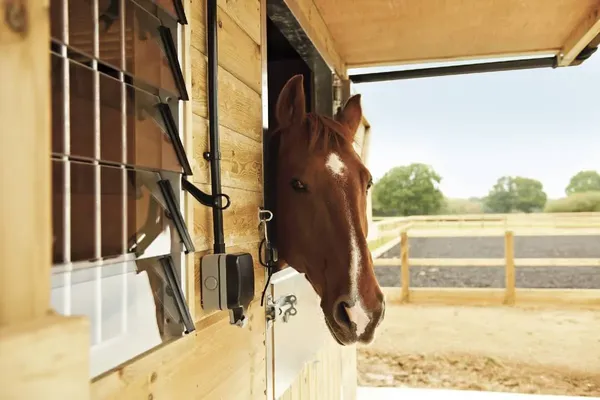
Stable doors should be at least 1.25m (4ft) wide. The door and roof should also allow the horse to look outside comfortably.
Size is not the only factor. Consider your horse’s overall build, age, health and temperament.
A broad horse may need more room than another horse of the same height. Older horses or those with mobility problems may also benefit from extra space when turning, lying down and getting up.
Think about how long your horse usually spends in their box. A horse that stays inside for extended periods may benefit from more room than one that only comes in for short periods.
The box should provide a comfortable place to rest without limiting normal movement.
Our guide to designing horse stables for rest and relaxation explains how space, box position, light and noise can help horses settle.
Your horse should be able to turn around easily and lie down with their head, neck and legs in a natural position. They should also have enough room to get up without hitting the walls, doors or fittings.
Keep fixtures to a minimum and position them carefully. Avoid sharp edges or anything that could catch a rug, headcollar or limb.
The space outside each box matters too. Passageways should be wide enough to lead horses safely without bringing them too close to horses in neighbouring boxes.
Allow room for doors to open safely and for people to move feed, bedding and equipment around the yard.
If you are planning several boxes, compare different stable block layouts before deciding how to arrange them.
A larger box will not compensate for poor airflow. The roof height, doors, windows and ventilation openings must work together to bring fresh air into the building.
Good ventilation helps control heat, moisture, dust and stale air. Read our guide to effective stable ventilation for more advice.
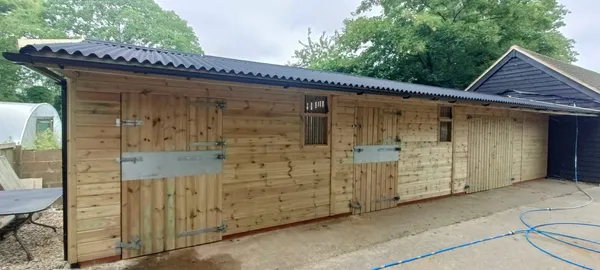
Chart Stables’ standard horse boxes measure 3.6m × 3.6m (12ft × 12ft), which suits most horses. We also offer larger boxes for taller horses, foaling mares and animals that need additional room.
You can combine boxes of different sizes within the same yard and add a tack room, feed store, hay store or wash bay. We design wooden stable blocks and American barns around your horses, land, routine and budget.
Contact our team to discuss your horses and find the right dimensions for your building.
What is a good size for a horse stable?
The British Horse Society recommends at least 3.65m × 3.65m (12ft × 12ft) for most horses. Large horses measuring 17hh or more need at least 3.65m × 4.25m (12ft × 14ft).
What size stable does a 16.2hh horse need?
A 16.2hh horse generally needs a stable measuring at least 3.65m × 3.65m (12ft × 12ft). Consider a larger box if the horse has a broad build or spends long periods inside.
What size stable does a 15.2hh horse need?
A stable measuring at least 3.65m × 3.65m (12ft × 12ft) should suit most 15.2hh horses. Height is not the only factor, consider your horse’s build, health and mobility too.
Is a 10ft × 10ft stable big enough for a horse? The British Horse Society recommends a 10ft × 10ft stable for a pony, not a horse. Most horses need at least 12ft × 12ft.
What is the standard horse stable size in the UK?
The British Horse Society recommends a minimum size of 3.65m × 3.65m (12ft × 12ft) for most horses.
How high should a stable roof be?
The British Horse Society recommends leaving 60–90cm (2–3ft) of clear space between the horse’s ears and the eaves when the horse stands normally.
What is the average stable size in metres?
A standard horse box commonly measures around 3.6m × 3.6m. The British Horse Society’s recommended minimum for most horses is 3.65m × 3.65m.