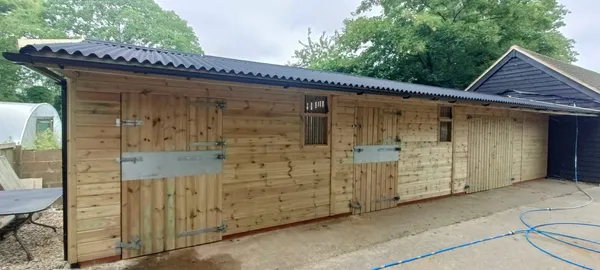
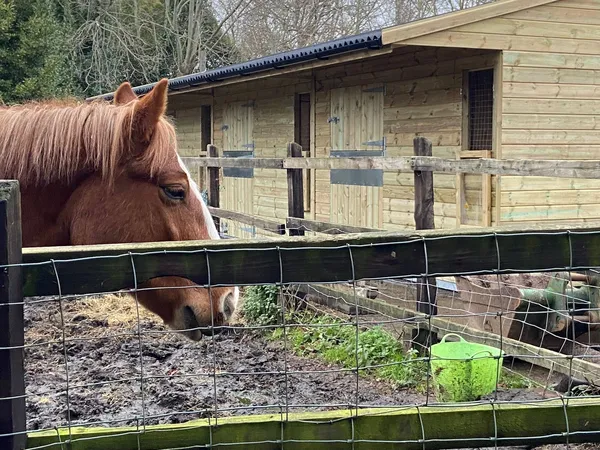
A mobile stable is a stable block built on skids or runners rather than a permanent concrete base. You can move it around your property or relocate it to another yard using its towing chain and a tractor or suitable 4×4.
Fixed stables, by comparison, are installed permanently on foundations and cannot be relocated.
Below, we compare mobile and fixed stables in more detail to help you choose.

Mobile stables are incredibly flexible. You can move them around your paddock when needed. This is especially useful if you have a modest property and need to manage your pasture efficiently, or if you want to keep your horses in shaded or sheltered areas at different times of the year. You could also move them into the yard for winter.
Moving them can help reduce mud build-up. If you rent your paddock or yard, you can relocate the stables when your agreement ends.
Fixed stables are permanent, so they cannot be moved once erected.
Mobile stables can be ordered online or over the phone and installed without permanent foundations. They may not need planning permission, but this depends on the building, site and how you plan to use it.
To build fixed stables, you may need to make a planning application, depending on the site and intended use. Most non-major applications have a target decision time of eight weeks, although they can take longer. Once you have permission, lay a concrete slab and allow it to cure before installing the stables. Overall, fixed stables usually take longer to prepare for and install.
Fixed stables are designed to be sturdy and durable.
Mobile stables, on the other hand, are relocated often, so you might need to tighten the hinges and fittings of moving parts every now and then. They aren’t insubstantial, though. They are well-built and robust and can endure multiple relocations.
.avif)
Mobile stables may require additional checks if you move them frequently, particularly around the skids, towing chain, hinges and fittings.
Fixed stables also need regular maintenance, including checks of the timber, roof, doors, guttering and drainage.
Mobile stables can cost less overall to install because they do not need permanent foundations or groundworks. They may also avoid the cost of a planning application, depending on the building, site and use.
Fixed stables can be slightly cheaper to buy. However, foundations, groundworks and possible planning costs can increase the overall price.
A fixed stable block can increase your property value, as it is a permanent asset. You might attract the equestrian niche market when you sell your home. Moreover, fixed stables can generate some extra income: you can rent stalls to neighbouring horse owners. Check the planning, insurance and tax requirements first.
Mobile stables are less likely to affect the property’s value because they are not permanent. However, you can take them with you or sell them separately.
Mobile stables may not need planning permission if they remain genuinely movable and are not fixed to the ground. However, your Local Planning Authority will consider their size, construction, use and permanence.
Fixed stables usually need planning permission, especially on agricultural or paddock land. Some private stables within the grounds of a home may fall under permitted development rights if they meet the relevant limits.
Sites within Green Belt, National Landscapes, conservation areas or near listed buildings may face additional restrictions.
Always check with your Local Planning Authority before ordering either type of stable. Read our guide to planning permission for stables for more information.

Both mobile and fixed stables may qualify for capital allowances if you use them for a qualifying equestrian business. This could allow you to claim tax relief on some of their cost.
Fixed stables may qualify for the Structures and Buildings Allowance, subject to the relevant conditions. Structures within the grounds of a home do not qualify for this allowance.
Mobile stables may qualify as plant and machinery or as a structure, depending on their design, function and use. Read the current GOV.UK capital allowances guidance.
Speak to an accountant or tax adviser before making a claim, as eligibility depends on your business and circumstances.
At Chart Stables, we build fixed and mobile stables from high-quality, sustainably sourced, pressure-treated timber.
Our mobile stables come in different dimensions and feature a heavy-duty towing chain and galvanised metal or pressure-treated timber skids. You can add a feed store, hay store, additional windows, or even a tack room.
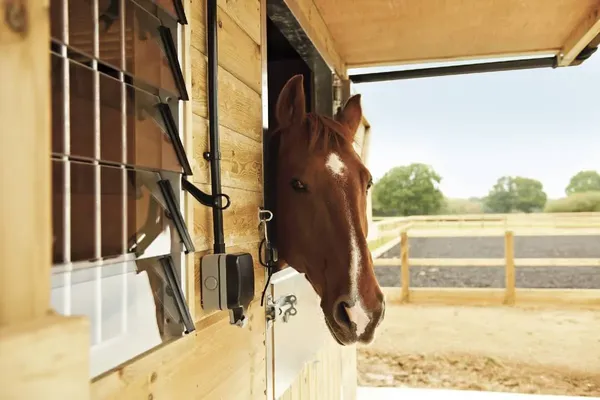
Our fixed stables can be fully customised with stalls of different sizes, a wash bay, hay store, tack room, feed room, windows and doors, as well as your preferred roofing, cladding and lining materials.
Explore our mobile stables and fixed wooden stables, or contact our team to discuss the best option for your horses, land and budget.
can be fully customised with different dimension stalls, a wash bay, a hay store, a tack room, a feed room, windows and doors, and your preferred roofing, cladding, and lining material.
Do mobile stables need planning permission?
Not always. A mobile stable may not need permission if it remains genuinely movable and is not fixed to the ground. The rules depend on its size, construction, use and location, so always check with your Local Planning Authority.
How long do mobile stables last?
A well-built mobile stable can last for many years. Its lifespan will depend on the materials, weather exposure, how often you move it and how well you maintain it.
Are mobile stables cheaper than fixed stables?
Mobile stables can cost less overall because they do not need permanent foundations or groundworks. However, fixed stables may have a lower purchase price, so compare the total project cost rather than the building price alone.
Can you claim capital allowances on stables?
You may qualify for capital allowances if you use the stables for an eligible equestrian business. The type of allowance depends on the building, its use and your circumstances. Ask an accountant or tax adviser before making a claim.